1
/
of
10
One Piece HandTailored Organic Cotton Authentic Buddhist Monk Monastic Robe,Kasaya Buddhist Monk Prayer/Meditation/Spiritual Cloth,Monk Gift
Regular price
$95.65 USD
Regular price
$0.00 USD
Sale price
$95.65 USD
THE THERAVEDA MONASTIC ROBE: UTTARASANGA
This Theravada Buddhist monk's robe is a distinctive garment worn by monks and nuns of the Theravada Buddhist tradition. Its design and color vary depending on the tradition and region, but its primary purpose is to symbolize the wearer's commitment to the spiritual path. Ordained Monks and Nuns, Monastic Leaders and Teachers, Monastic Students, Novices, and Lay Practitioners can wear this robe.
ORIGIN:
The practice of monastic robes dates back to Buddha's lifetime. Initially, monks adorned themselves with robes made from discarded fabric, embodying the principles of simplicity and detachment. The tradition of wearing monastic robes, known as a Kasaya, is deeply rooted in the practices of Buddhist monks and nuns, tracing back to the time of the Lord Buddha, nearly 2,500 years ago. These robes, often named after the saffron dye they were originally dyed with, symbolize a life of renunciation and commitment to a monastic lifestyle and spiritual practice.
Theravada is the closest thing one can get to the original form of Buddhism and is based on the Pali texts. The countries that have Theravada as their national religion are Myanmar, Thailand, Laos, Sri Lanka, and Cambodia. It dates back to the Buddha from the 5th century BCE.
THREE PIECES OF KASAYA ( MONASTIC ROBE) :
In Theravada Buddhism, the Kasaya or Buddhist monastic robe comprises three parts, collectively known as the "Triple Robe". This ensemble, believed to have remained unchanged since the Buddha's time, includes:
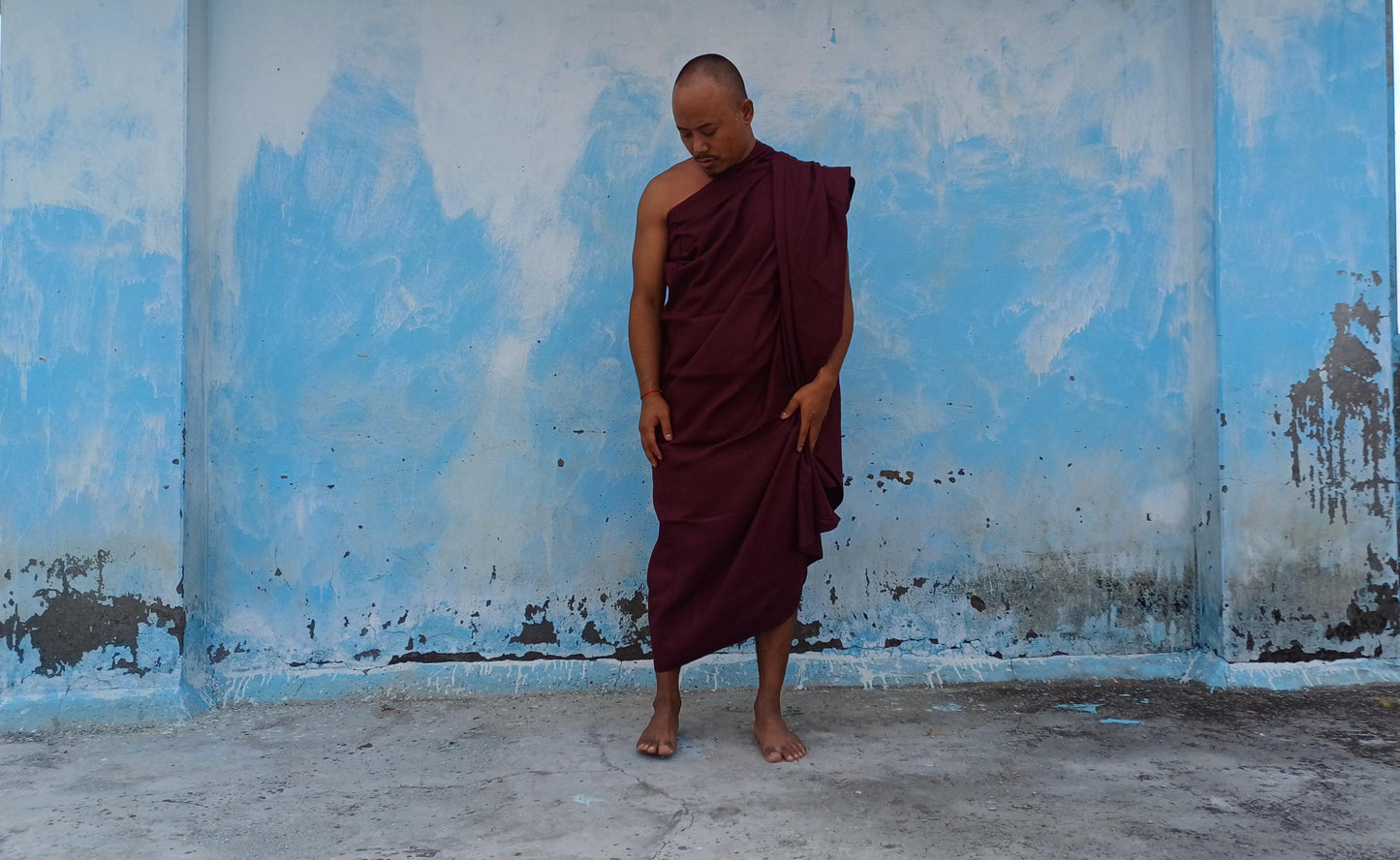
1. Uttarasanga: The main robe covering the body, leaving the right shoulder uncovered, symbolizes readiness for work.
2. Antaravasaka: The inner garment covering the lower body.
3. Sanghati: The outer robe used for additional warmth or formal occasions.
UTTARASANGA
The uttarasanga is the most prominent robe. It is sometimes also called the kashaya robe. It is a large rectangle, about 6 by 9 feet. It can be wrapped to cover both shoulders, but most often it is wrapped to cover the left shoulder, but leave the right shoulder and arm bare.
DESIGN :
In Theravada, the monks wear rectangular robes wrapped around their bodies. The robes have a pattern based on the look of rice paddy fields.
SYMBOLISM:
The robes represent the core principles of simplicity, humility, and detachment that are central to the Theravada monastic path. These robes, often named after the saffron dye they were originally dyed with, symbolize a life of renunciation and commitment to the spiritual path. This tradition underscores the Buddhist path's core values of modesty and non-attachment to material possessions.
PRODUCT SPECIFICATIONS:
MATERIAL:
Cotton
SIZE :
Length - 112 inches
Width - 83 inches
SHAPE :
Rectangular
DESIGN :
Stripe
Country of Origin :
Made in India
DISCLAIMER :
This product is handmade, and there may be irregularities and imperfections. This is a natural outcome of the handcrafting process and adds to the unique charm of the product.
NamasteYOGAstore: An Exclusive Outlet For Yoga, Meditation, and Spiritual Items
The store is dedicated only to handmade and handcrafted products from across the length and breadth of the country. They are labors of love made painstakingly by hand, and as such, no two products are alike. What's more, the products are sourced from the various corners of the country, directly from the artisans.
This Theravada Buddhist monk's robe is a distinctive garment worn by monks and nuns of the Theravada Buddhist tradition. Its design and color vary depending on the tradition and region, but its primary purpose is to symbolize the wearer's commitment to the spiritual path. Ordained Monks and Nuns, Monastic Leaders and Teachers, Monastic Students, Novices, and Lay Practitioners can wear this robe.
ORIGIN:
The practice of monastic robes dates back to Buddha's lifetime. Initially, monks adorned themselves with robes made from discarded fabric, embodying the principles of simplicity and detachment. The tradition of wearing monastic robes, known as a Kasaya, is deeply rooted in the practices of Buddhist monks and nuns, tracing back to the time of the Lord Buddha, nearly 2,500 years ago. These robes, often named after the saffron dye they were originally dyed with, symbolize a life of renunciation and commitment to a monastic lifestyle and spiritual practice.
Theravada is the closest thing one can get to the original form of Buddhism and is based on the Pali texts. The countries that have Theravada as their national religion are Myanmar, Thailand, Laos, Sri Lanka, and Cambodia. It dates back to the Buddha from the 5th century BCE.
THREE PIECES OF KASAYA ( MONASTIC ROBE) :
In Theravada Buddhism, the Kasaya or Buddhist monastic robe comprises three parts, collectively known as the "Triple Robe". This ensemble, believed to have remained unchanged since the Buddha's time, includes:
1. Uttarasanga: The main robe covering the body, leaving the right shoulder uncovered, symbolizes readiness for work.
2. Antaravasaka: The inner garment covering the lower body.
3. Sanghati: The outer robe used for additional warmth or formal occasions.
UTTARASANGA
The uttarasanga is the most prominent robe. It is sometimes also called the kashaya robe. It is a large rectangle, about 6 by 9 feet. It can be wrapped to cover both shoulders, but most often it is wrapped to cover the left shoulder, but leave the right shoulder and arm bare.
DESIGN :
In Theravada, the monks wear rectangular robes wrapped around their bodies. The robes have a pattern based on the look of rice paddy fields.
SYMBOLISM:
The robes represent the core principles of simplicity, humility, and detachment that are central to the Theravada monastic path. These robes, often named after the saffron dye they were originally dyed with, symbolize a life of renunciation and commitment to the spiritual path. This tradition underscores the Buddhist path's core values of modesty and non-attachment to material possessions.
PRODUCT SPECIFICATIONS:
MATERIAL:
Cotton
SIZE :
Length - 112 inches
Width - 83 inches
SHAPE :
Rectangular
DESIGN :
Stripe
Country of Origin :
Made in India
DISCLAIMER :
This product is handmade, and there may be irregularities and imperfections. This is a natural outcome of the handcrafting process and adds to the unique charm of the product.
NamasteYOGAstore: An Exclusive Outlet For Yoga, Meditation, and Spiritual Items
The store is dedicated only to handmade and handcrafted products from across the length and breadth of the country. They are labors of love made painstakingly by hand, and as such, no two products are alike. What's more, the products are sourced from the various corners of the country, directly from the artisans.
Product features
Product features
Materials and care
Materials and care
Merchandising tips
Merchandising tips
Share